
The Middle East is a project-driven market for height adjustable desk frames, not a search-driven one. In Saudi Arabia and the UAE, orders come through importers, distributors and fit-out contractors — and the first question is almost always about compliance documents, not price. This guide explains what you need to import dual motor desk frames into Saudi Arabia and the wider GCC, and what to confirm before you place an order.
The GCC standing desk market is small compared with North America or Europe, but it is growing fast, driven by Saudi Vision 2030, new office developments in Riyadh, NEOM and The Line, smart-government programmes in the UAE, and regional headquarters moving into Dubai and Abu Dhabi. Office furniture demand in Saudi Arabia alone is growing steadily, and adjustable desks are increasingly specified in new office space.
But do not expect online traffic to deliver these orders. Our own search data shows the Middle East is almost invisible in search: the UAE generated 50 impressions and Saudi Arabia 35 in the last three months, with one click each. Middle East business comes through importer and distributor relationships, project contractors and exhibitions — not through Google. This post exists so that when an importer or project buyer does find us, the compliance answers are already on the page.
SABER is the Saudi Standards, Metrology and Quality Organization (SASO) mandatory online platform. Every product imported into Saudi Arabia must be registered on SABER, and the process has two certificates:
The Saudi importer registers on SABER; the exporter supplies the test reports, product data and photos. Which technical regulations apply depends on the product’s HS code — confirm the HS code with your Saudi importer on SABER before quoting, because the HS code decides the compliance path. The electrical parts of a desk frame fall under low-voltage, EMC and hazardous-substance regulations.
CB test reports can support the process: for some electrical products, a SASO IECEE Recognition Certificate is needed, based on a CB test report and CB certificate, including Saudi national differences such as the plug standard SASO 2203.
What to ask your supplier: ask for the test reports by exact model that support a SABER registration, and confirm the HS code with your importer first. Test reports and certificates are available on request, by market and model.
The G-Mark (Gulf Conformity Mark) is the GSO (Gulf Standardization Organization) mandatory certification for low-voltage electrical equipment, covering all six GCC countries: Bahrain, Kuwait, Saudi Arabia, Oman, Qatar and the UAE. It is handled by a GSO-notified body. If you distribute across the Gulf, G-Mark evidence covers the region in a way a single-country certificate does not.
In the UAE, the Ministry of Industry and Advanced Technology (MoIAT) runs ECAS (Emirates Conformity Assessment Scheme) for low-voltage electrical products. ECAS is mandatory; EQM (Emirates Quality Mark) is a voluntary quality mark on top of it. A frame shipping to Dubai or Abu Dhabi needs ECAS evidence; a frame shipping to Riyadh needs SABER.
A common misunderstanding: CE test reports can support a SABER, G-Mark or ECAS application as test evidence, but CE itself is not a legal import mark in Saudi Arabia or the UAE. Do not accept a supplier who presents CE as proof of Middle East compliance. Ask for the SABER, G-Mark or ECAS evidence for the specific market you are importing into.
| Market | Voltage / frequency | Plug |
|---|---|---|
| UAE | 230V, 50 Hz | Type G (BS 1363) |
| Saudi Arabia | 230V, 60 Hz | Type G (new buildings; older buildings may still have Type A/B) |
| Qatar, Bahrain, Kuwait, Oman | 230–240V, 50 Hz | Type G |
The whole Gulf uses Type G plugs, which simplifies the plug question. The frequency question does not simplify: Saudi Arabia runs on 60 Hz, while the UAE and the rest of the Gulf run on 50 Hz. A control box rated for 50 Hz only may not run correctly on a Saudi 60 Hz supply.
Confirm with the factory before ordering for Saudi 60 Hz. Do not assume a frame is 50/60 Hz compatible — ask for confirmation for the exact model and control box you are buying, in writing, before the order is placed. This is the single most common electrical mistake in Saudi desk frame orders.
Arabic labelling is also required in Saudi Arabia. Confirm Arabic labels and instruction manuals before shipment.
Middle East orders are usually project orders — a fit-out, a government office, a corporate headquarters, a school or a hospital. What those buyers need from a supplier:
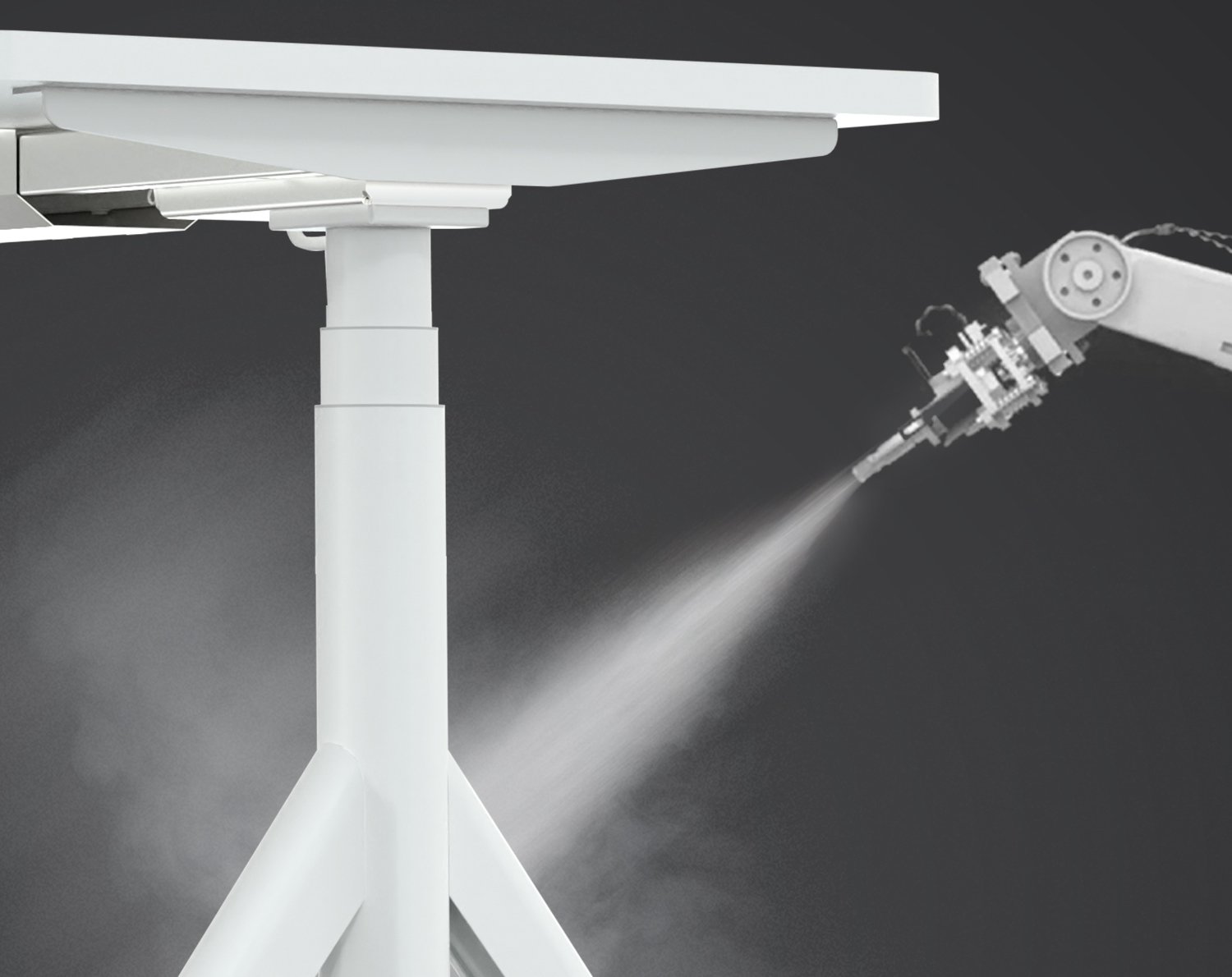
Joyergon manufactures in its own factory in Shengzhou City, Zhejiang, China, founded in 2017, with a production team with 15 years of frame-making experience. Frames are produced with die-casting equipment and automatic welding robots, so repeat orders match the approved sample.

Joyergon manufactures dual motor frames in 2-leg, 3-leg and 4-leg layouts. All figures below are static load, measured on the frame as supplied.
| Model | Legs / segments | Static load | Height range | Speed |
|---|---|---|---|---|
| Joy2M2L2S | 2-leg, 2-segment | 120 kg | 700–1150 mm | 20–38 mm/s |
| Joy2M2L3S | 2-leg, 3-segment | 120 kg | 600–1250 mm | 25–45 mm/s |
| Joy3M3L3S | 3-leg, 3-segment | 150 kg | 600–1250 mm | 30–45 mm/s |
| Joy4M4L3S | 4-leg, 3-segment | 120 kg | 600–1250 mm | 30–38 mm/s |
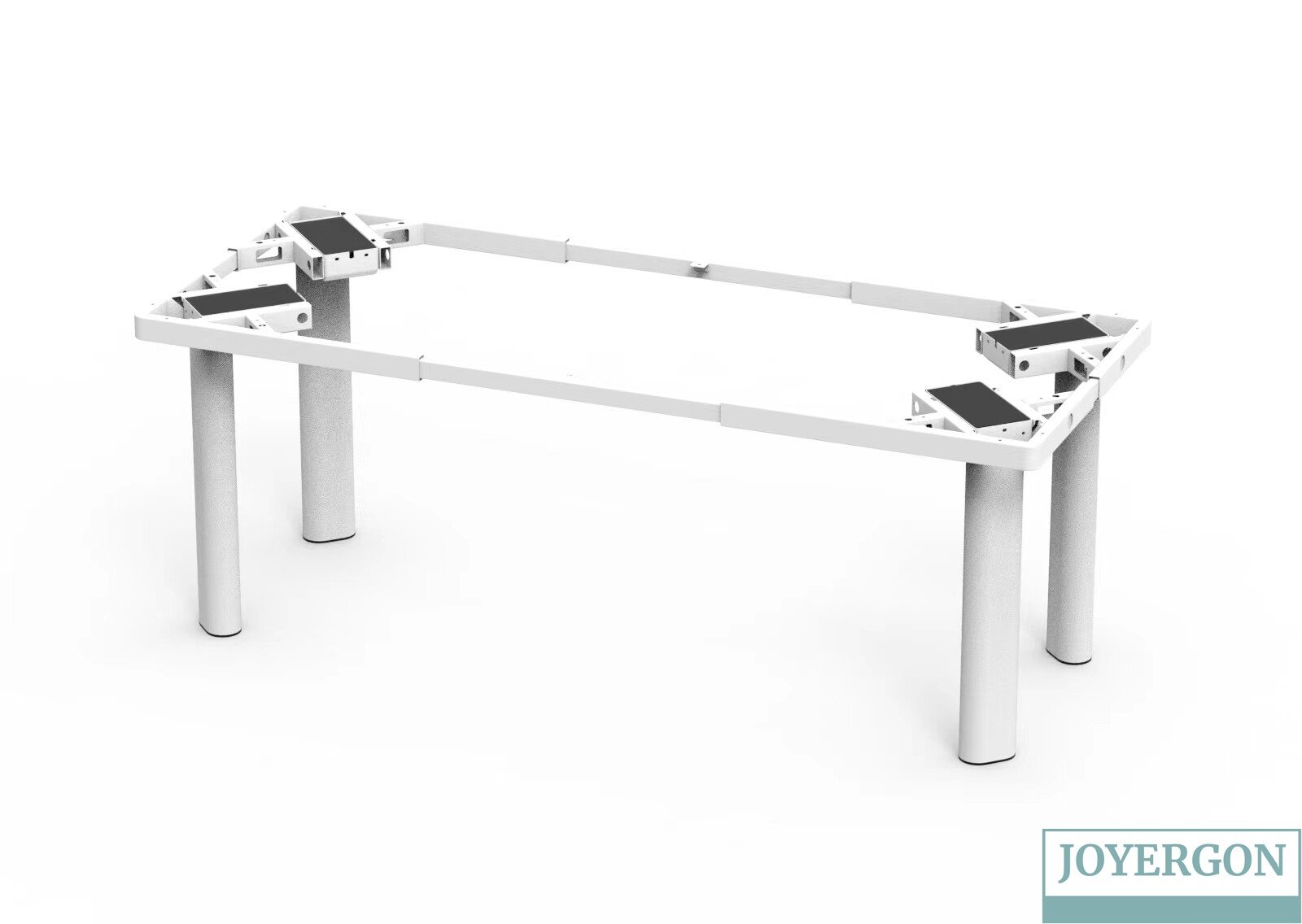
The Joy2M2L3S (2-leg, 3-segment) is the volume model for standard office and government bulk orders. The Joy3M3L3S in 90° L-shape fits executive offices and corner workstations — large desktops and L-shapes are preferred in Middle East executive offices. The Joy4M4L3S fits meeting tables, shared workstations and project batches. Pneumatic (gas-spring, power-free) frames are also available for education, healthcare and library settings where there is no power outlet at every desk.
Single-motor frames (SM-1 to SM-4, static load 50–80 kg) remain available for entry-level ranges.
Customisation covers frame colour, logo, handset functions, packaging, carton marks and Arabic labelling, with voltage and plug type set for the destination market at quotation. Joyergon offers a 5-year warranty on all components — lifting columns, motors, control box and handset.
Q: What documents do I need to import desk frames into Saudi Arabia?
A: Registration on SABER, with a PCoC (valid one year) and an SCoC for each shipment. Your Saudi importer registers; the exporter supplies test reports, product data and photos. Confirm the HS code with your importer on SABER before quoting.
Q: Is CE enough to import into Saudi Arabia or the UAE?
A: No. CE reports can support an application as test evidence, but CE is not a legal import mark in either country. Saudi Arabia needs SABER; the UAE needs ECAS; the GCC needs G-Mark for low-voltage electrical equipment.
Q: What voltage and plug do Saudi frames use?
A: 230V, 60 Hz, Type G plugs (BS 1363). Note the frequency: Saudi Arabia is 60 Hz, unlike the UAE at 50 Hz. Confirm 60 Hz compatibility with the factory for the exact model and control box before ordering.
Q: Does G-Mark cover the whole Gulf?
A: Yes. G-Mark is the GSO mandatory mark for low-voltage electrical equipment across all six GCC countries: Bahrain, Kuwait, Saudi Arabia, Oman, Qatar and the UAE.
Q: Can I trial a small quantity first?
A: Yes. Trial orders start from 5 units. Standard samples are ready in 5 days, and the sample fee is refunded against a confirmed bulk order.
Request a Quote
Sourcing dual motor frames for Saudi Arabia or the wider GCC? Send your desktop size, target load and quantity, your destination country (UAE / Saudi Arabia / Qatar / other) and your project type (office / education / healthcare / government). We reply within 12 hours with a matched configuration and quotation.
