
Column selection
The number of telescopic sections in a lifting column decides the lowest seated height, the tallest standing height, the closed length of the frame and the carton. On our platform a two-stage column covers 700–1150 mm with a 500 mm stroke; a three-stage column reaches 600–1250 mm with a 650 mm nominal stroke. Both carry a 120 kg static rating. This page compares the published figures and explains which product ranges each one suits.
Request a quoteExplore frames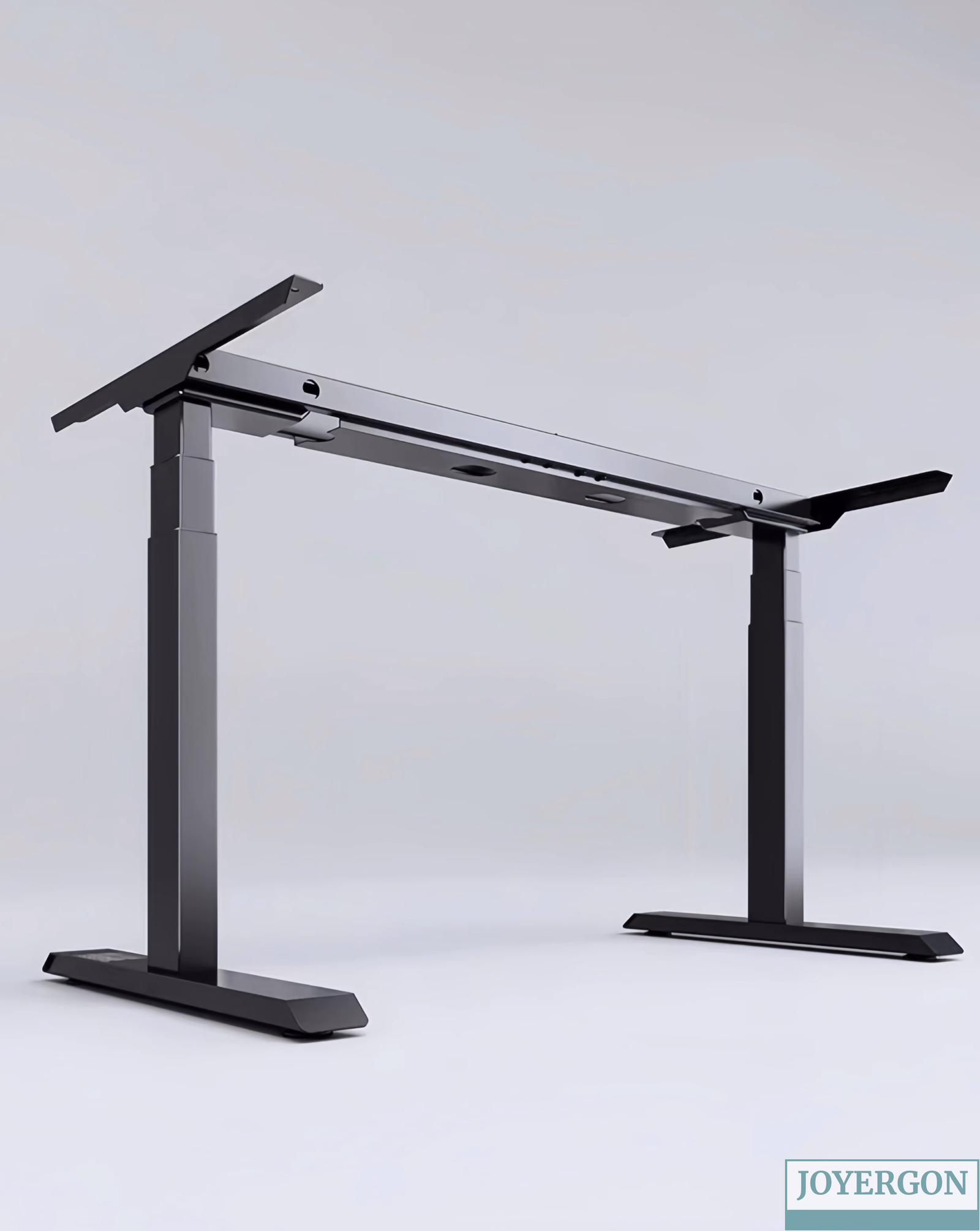
The decision
Two nested sections or three — the range you need decides the column.
A two-stage column has an outer tube and one inner tube; a three-stage column adds a second nested section. That extra section lets the frame start lower and finish higher without making the closed column longer. On our published data the two-stage Joy2M2L2S runs 700–1150 mm with a 500 mm stroke, while the three-stage Joy2M2L3S runs 600–1250 mm — a 100 mm lower seated position and a 100 mm higher standing position, from a 650 mm nominal stroke.
Why does the lower end matter? Ergonomic programmes are specified around real users, not catalogue numbers. A finished desk with a 25 mm top needs to sit near 735–760 mm for a seated user, and near 1120–1220 mm for standing users around 175–185 cm. A frame that starts at 700 mm gives less room for a thick top, a keyboard tray or a shorter user; a 600 mm starting point leaves margin for all three. That is the main reason flagship and project ranges move to three-stage columns.
The upper end matters for the same reason in reverse. If the frame stops at 1150 mm, a tall user on a thick top is already near the limit. The 600–1250 mm three-stage range covers the full seated-to-standing envelope on one platform, which simplifies a range: one frame family, one control configuration and one documentation pack for every market height requirement.
Published data
Both rows are published reference values for our dual-motor two-leg platform. Figures are frame-only, measured without the desktop.
| Parameter | 2-stage · Joy2M2L2S | 3-stage · Joy2M2L3S |
|---|---|---|
| Lift column | 2 segments (two-stage) | 3-stage telescopic steel |
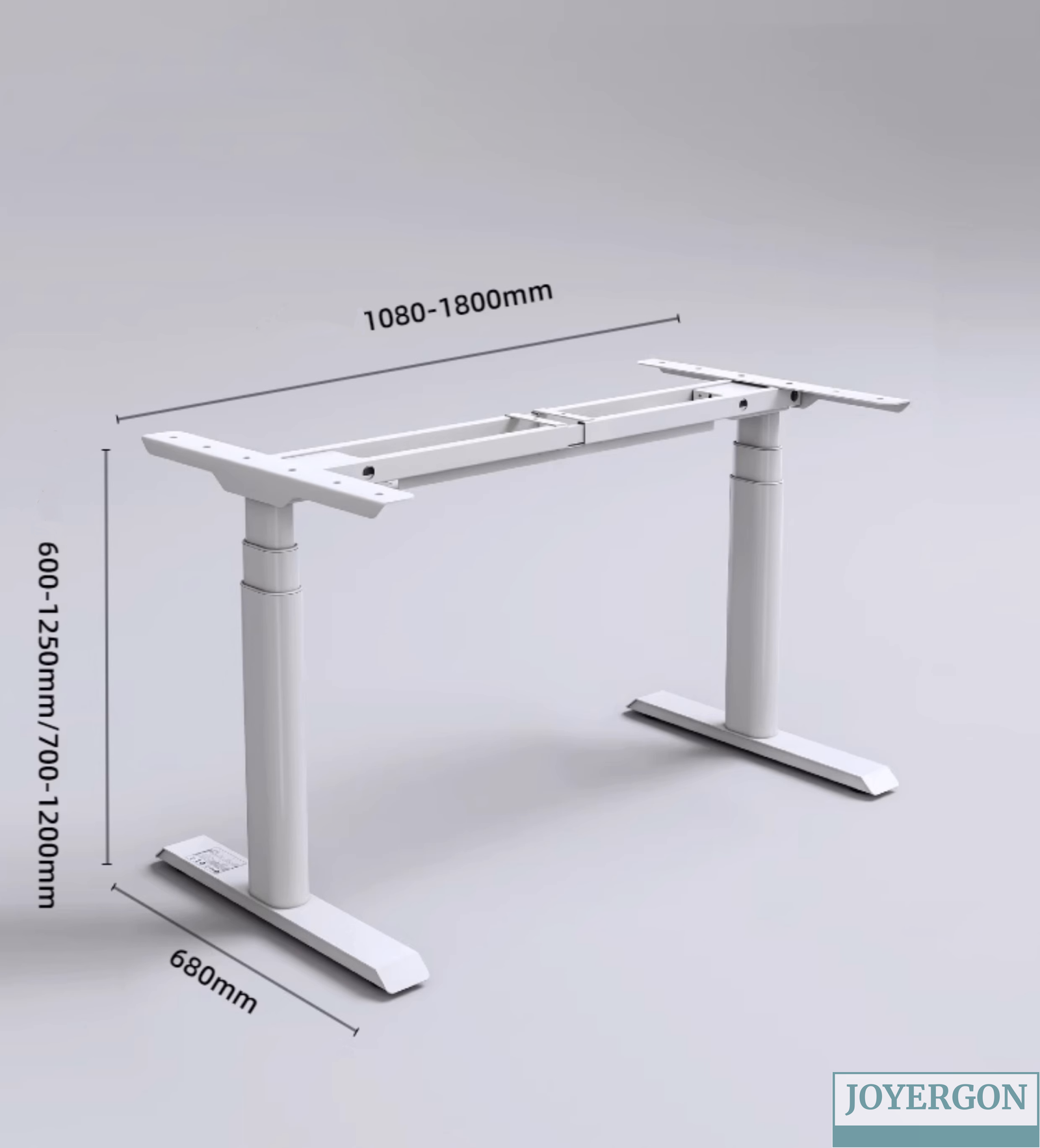
| Height range | 700–1150 mm | 600–1250 mm |
| Stroke | 500 mm | 650 mm nominal |
| Frame / width range | 1100–1700 mm | 1020–1800 mm |
| Static load | 120 kg | 120 kg |
| Lift speed | 20–38 mm/s | 25–45 mm/s at rated load |
| Operation noise | Under 48 dB | Under 48 dB(A) at one metre |
| Closed / installation dimension | Set by the 2-section build | 560 mm column length when closed |
| Safety | Gyroscope anti-collision, thermal and overload protection | Anti-collision, thermal and overload protection |
| Memory | 3 / 4 presets, customisable | Memory presets via the handset |
| Best fit | Catalogue desks, value and standard ranges | Flagship ranges, ergonomic programmes, tall-user markets |
Real parts, real drawings
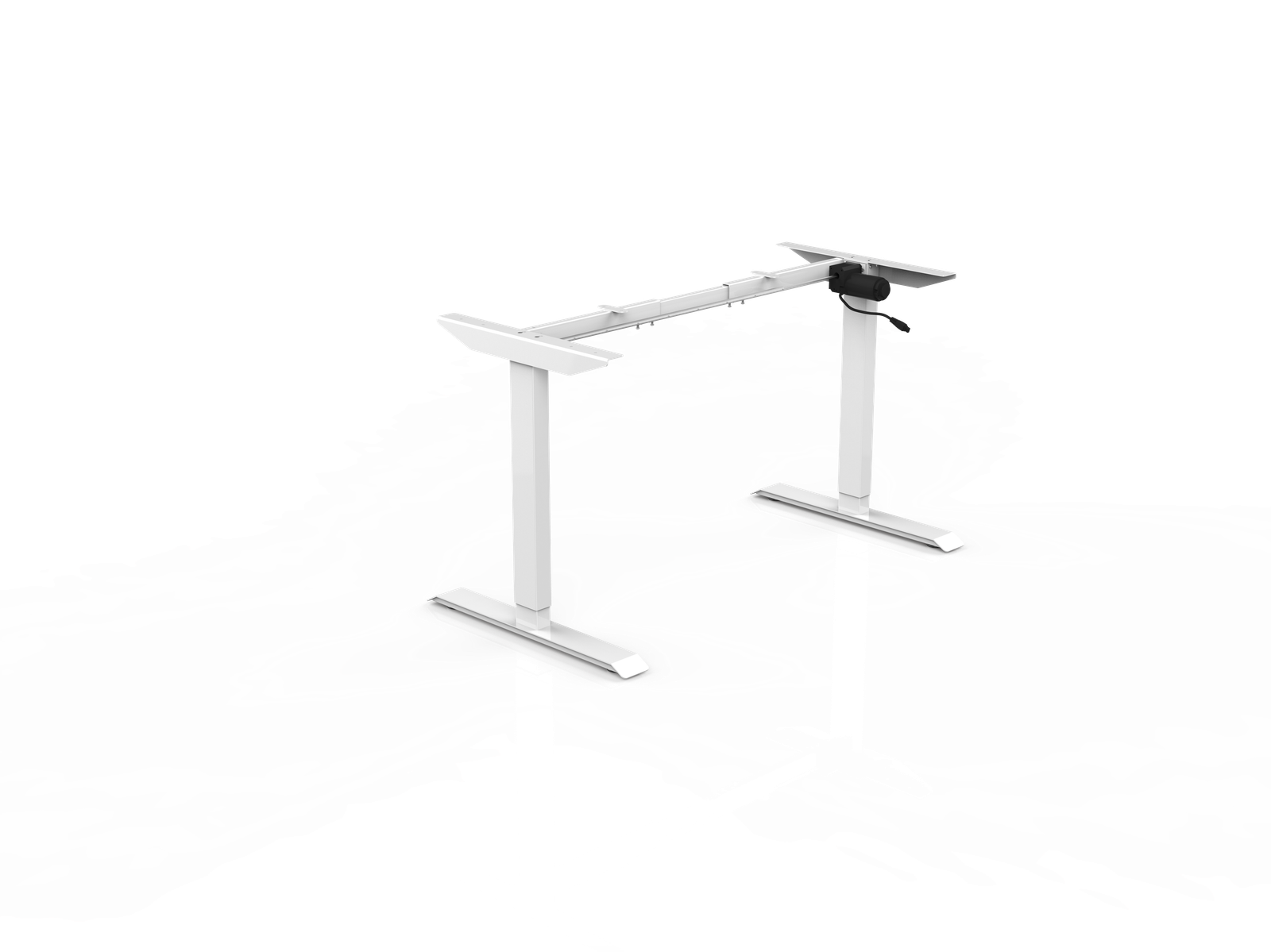
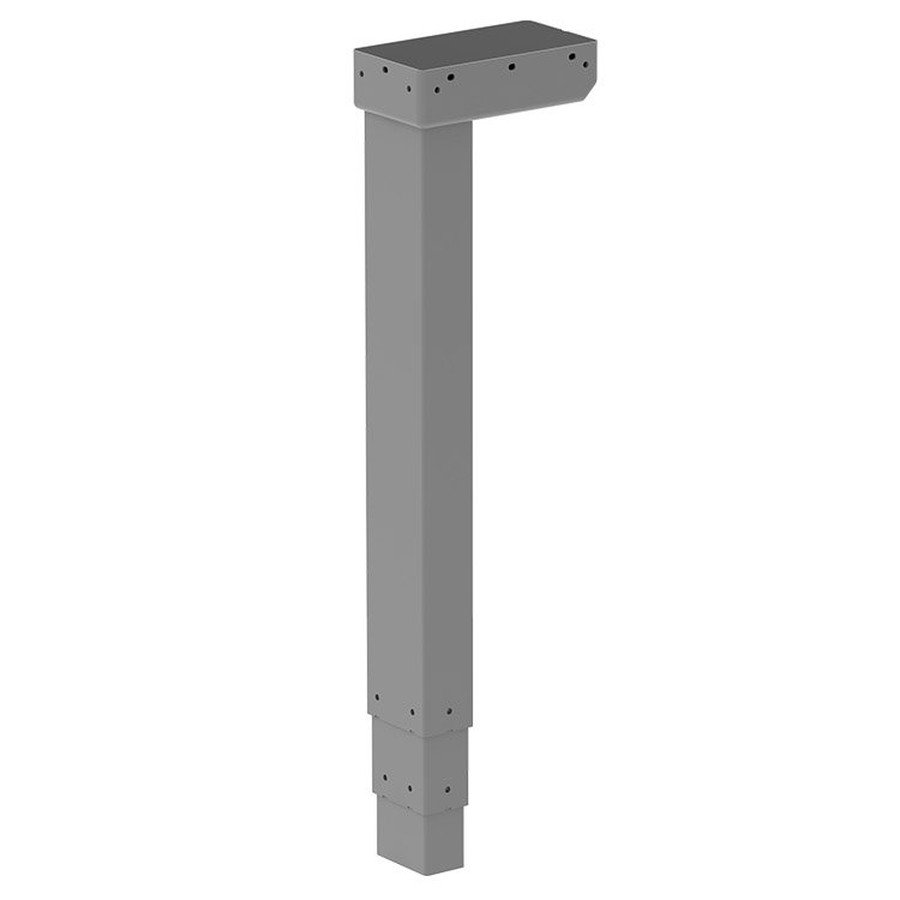
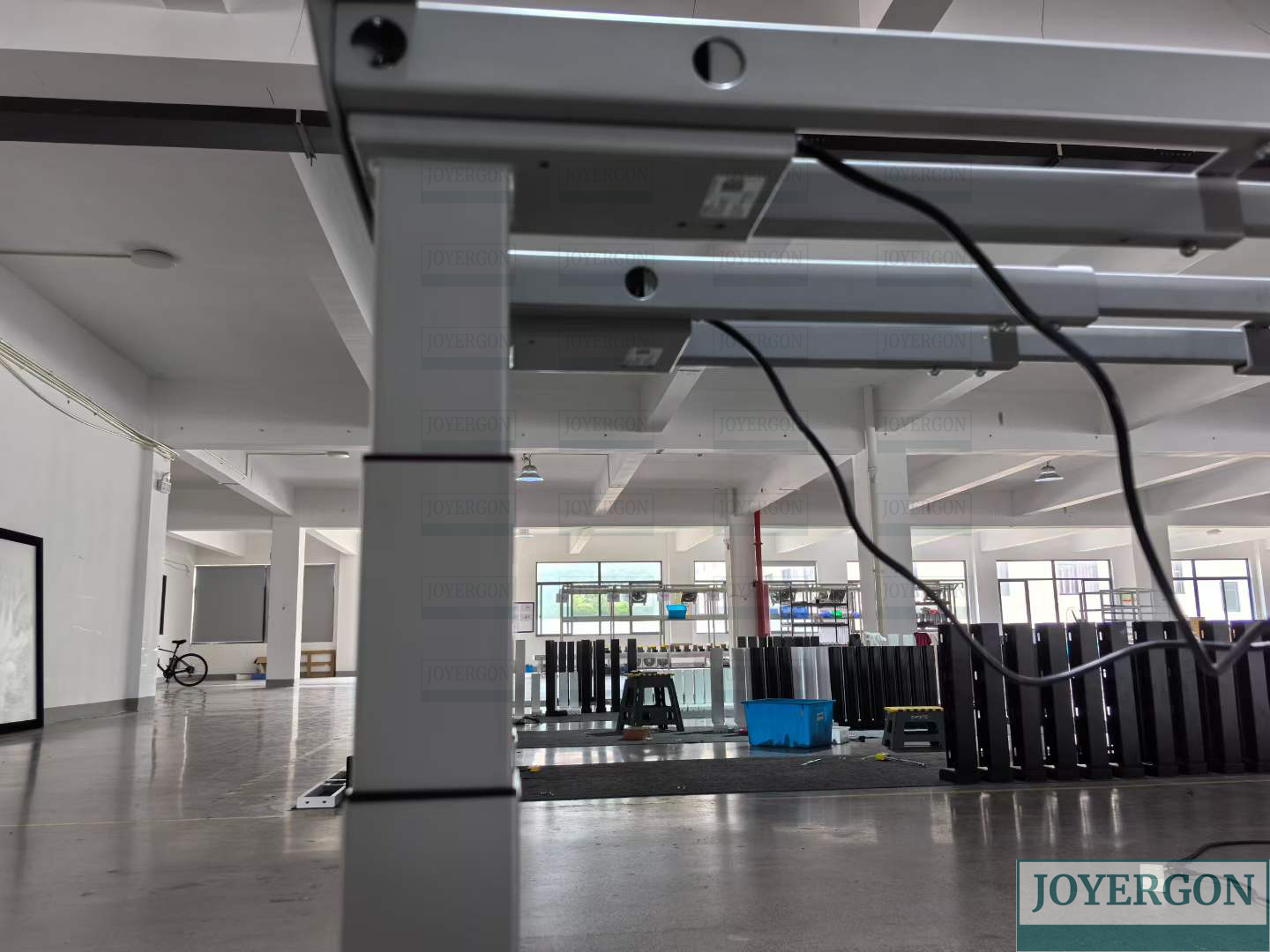
Two-stage and three-stage frames, a column close-up, a dimensioned specification photograph and the tube stock they are made from.
Geometry
The 560 mm figure is a packing number as much as an ergonomic one.
The three-stage platform publishes a 560 mm installation dimension — the column length when closed — against a 650 mm nominal stroke. That ratio is the point of the design: the frame folds short enough to sit under a low desktop, yet extends far enough to cover the full seated-to-standing envelope. The two-stage build uses a 500 mm stroke to reach 700–1150 mm, which suits a standard range but leaves less margin for thick tops and shorter users.
Closed length also sets the carton. A shorter closed column packs into a smaller carton, and carton cube drives landed cost, container loading and parcel-carrier handling. On our line, tube cutting, forming, welding, drilling, coating and assembly all happen under one roof, so the frame setting, the packing sequence and the carton labels are released together. Separate and combined carton options are quoted per programme, and the packing list states the contents by part number.
Range logic
The column is a product-positioning decision as much as a mechanical one.
A two-stage column is the workhorse behind catalogue desks. It keeps cost and packaging lean for a standard 700–1150 mm range, which covers most value retail, education and general office listings. The same frame can ship with different column sections and handset options, so a brand can cover several price points without re-engineering the control configuration. Single-motor two-leg frames in our range publish a 700–1200 mm typical height range, 1000–1600 mm width, 100 kg static load and 20–30 mm/s speed — a different platform again, chosen for entry tiers.
A three-stage column belongs in a flagship and project range. The 600–1250 mm travel supports ergonomic programmes, tall-user markets and specification-led tenders where the height range is written into the brief. It is also the platform used on our three-leg and four-leg frames, where a 650 mm nominal stroke and 560 mm closed length have to work across three or four columns held level by one control box. Choosing one stage across a range keeps the drawing, the spec sheet and the spare parts list consistent.
Commercial
Where the extra section pays for itself — and where it does not.
A three-stage column uses more tube, more forming operations and a tighter stroke tolerance, so it sits above the two-stage platform on unit cost. It earns that difference when the range needs the full 600–1250 mm envelope, when one frame has to serve several markets with different height expectations, or when a project brief specifies the travel. If a catalogue range is written around 720–1180 mm, the two-stage platform does the job with a shorter stack and a leaner carton.
Either way, the numbers are fixed on the drawing and the approved sample. Standard samples take 5 days, custom and OEM samples 7 or 15 days, and bulk production 20–25 days after approval, with quotes returned within 2 hours on working days. Order scale grows from trial batches to full containers on the same line, so a programme that starts on two-stage and later adds a three-stage flagship keeps one documentation pack and one quality system.
Manufacturing
Section, wall thickness, stroke and finish are released together.
A column specification covers section shape and size, wall thickness, stage count, stroke, finish and mounting interface. Rectangular, square, oval and round sections are available depending on model — including the 70 × 70 mm square tube — and the section is agreed on the drawing before a roll or die is cut. Changing the section changes the load rating and the stroke, so those values are re-confirmed on the sample rather than carried over from a previous model.
On the line, cut length is held to ±0.5 mm typical, hole position to ±0.3 mm within a part and ±0.5 mm across parts, and powder-coat film build to 60–90 μm typical. Weld distortion is controlled by the jig and checked on the first article; colour is matched to an approved physical panel. Every frame is then run through a full-travel cycle with noise and level checks before packing, and the OQC report and packing photos are kept per batch. Those records are what let a tenth container match the first sample.
Questions buyers ask
Two-stage columns cover 700–1150 mm with a 500 mm stroke; three-stage columns reach 600–1250 mm with a 650 mm nominal stroke. Both carry a 120 kg static rating — the difference is travel and closed height.
No. Both our two-stage and three-stage dual-motor platforms publish a 120 kg static rating. Load capacity comes from the column section, the beam and the feet, not from the number of nested sections.
Stability is a property of the assembled frame: column section, foot length, beam section and load distribution. We check level accuracy through the full stroke on the first article and on the pre-shipment cycle test, and publish the even load for the assembled configuration.
The two-stage platform, if 700–1150 mm covers your users. It keeps the carton lean and the unit cost lower for catalogue, education and retail listings. Move to three-stage when the brief calls for 600–1250 mm.
Yes, but it is a new specification. A new section means new tooling, and the load rating and stroke are re-confirmed on a physical sample. That is why we lock the section on the drawing before artwork and tooling are released.
The lowest seated height, the clearance under the desktop, the carton size and the loading plan. It is stated on the dimension drawing and checked on the first article of each batch.
Dimension drawing (PDF, DWG on request), spec sheet, assembly guide, packing list, fault tree and spare parts list, plus material and coating declarations on request.
Keep specifying
Tell us the height range your market needs, the desktop thickness and the target price position. We will return the stage recommendation, the dimension drawing and a costed quotation within 2 hours on working days.
Request a quoteWhatsApp +86 133 8298 7751Or email hi@joyergon.com
